
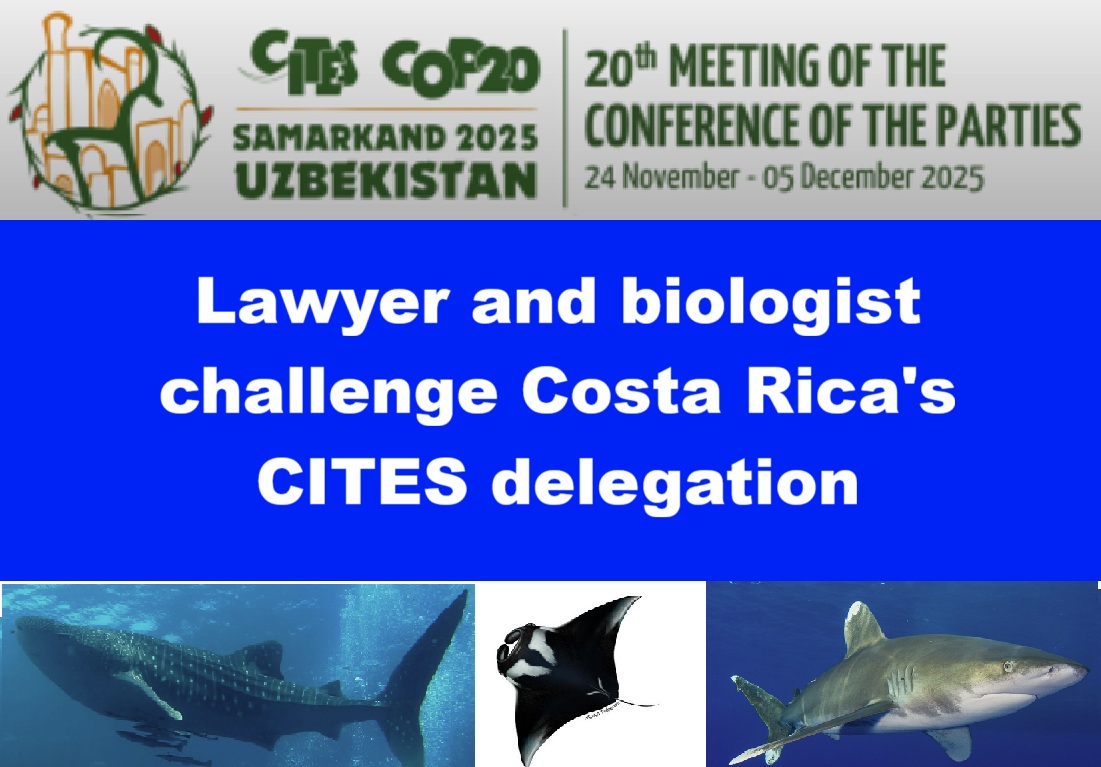
They point to non-compliance with national legislation
(San José, Costa Rica – November 17, 2025). Costa Rican attorney Walter Brenes and biologist Randall Arauz sent a letter today addressed to the President of the Republic of Costa Rica, Rodrigo Chaves, as well as to his Minister of Environment (MINAE), Tattenbach; the Executive Director of INCOPESCA, Carranza; and his Minister of Foreign Affairs, André Tinoco, opposing the composition of the Costa Rican delegation that will represent the country at the Twentieth Conference of the Parties (CoP20) of the Convention on International Trade in Endangered Species of Wild Fauna and Flora (CITES), to be held from next November 24 to December 5 in Samarkand, Uzbekistan.
The attorney and the biologist assert that the composition of the delegation does not comply with the Wildlife Conservation Law (WCL), the enforcement of which was ordered by the 1st Hall of Appeals of the Supreme Court of Justice (Case No. 17-008322-1027-CA, Ruling No. 000912-F-S1-2023).
Specifically, they note that the 1st Hall of Appeals of the Supreme Court of Justice annulled INCOPESCA’s declaration of species of commercial interest for endangered marine wildlife species protected by CITES (AJDIP 290/2017) and ordered compliance with the WCL for any species included in the List of Endangered or Threatened Marine-Coastal Wildlife Species of the National System of Protected Areas (SINAC). Thus, they explain that the correct procedure is that Costa Rica’s CITES Management Authority must be represented solely by SINAC (Article 71 of the WCL), and the Scientific Authority must be designated according to the Wildlife Conservation Law Regulations (Executive Decree 40548-MINAE, La Gaceta No. 150, Supplement No. 194, August 9, 2017).
The attorney and the biologist question the participation of officials from the Costa Rican Institute of Fisheries and Aquaculture (INCOPESCA) as members of the Costa Rican delegation acting as CITES Management and Scientific Authorities, since this constitutes an irrefutable violation of what is established in the WCL and its Regulations. In the same context, they argue that the role of Mr. Johnny Mauricio González, Representative of the National Longline Sector Federation and CITES Advisor for species of fisheries and aquaculture interest (FEDENAP), makes no sense, given that CITES deals with wildlife species endangered by international trade, whereas species of fisheries and aquaculture interest are addressed within Regional Fisheries Management Organizations (RFMOs).
“CITES aims to regulate the international trade of threatened species so that such trade—if allowed—takes place in a traceable and legal manner,” explained biologist Randall Arauz of Marine Watch International. “Evidently, Costa Rica’s position and credibility at such an event is seriously undermined, particularly if the national delegation is composed in a manner contrary to our own legal framework.”
“Shamefully, we have an INCOPESCA that issues regulations contrary to our legal system, and a MINAE submissive to INCOPESCA that accepts such regulations without question, all for the sole purpose of favoring the sector that exports fins of endangered shark species,” denounced attorney Walter Brenes of Energy Law Firm. “The orders of the 1st Chamber of Appeals of the Supreme Court of Justice are clear: both MINAE and INCOPESCA must comply with the WCL when dealing with endangered marine species that are acknowledged as such by the Costa Rican State, and these appointments within the Costa Rican CITES delegation constitute yet another violation of the orders of the country’s highest judicial authority,” Brenes concluded.
For more information:
Walter Brenes
Energy Law Firm
wbrenes@elawf.com
(506) 8995 3068
Randall Arauz
Marine Watch International
rarauz@marinewatch.org
(506) 8708 8253